Computational Optimization of Liquid Crystal Elastomers (LCEs)
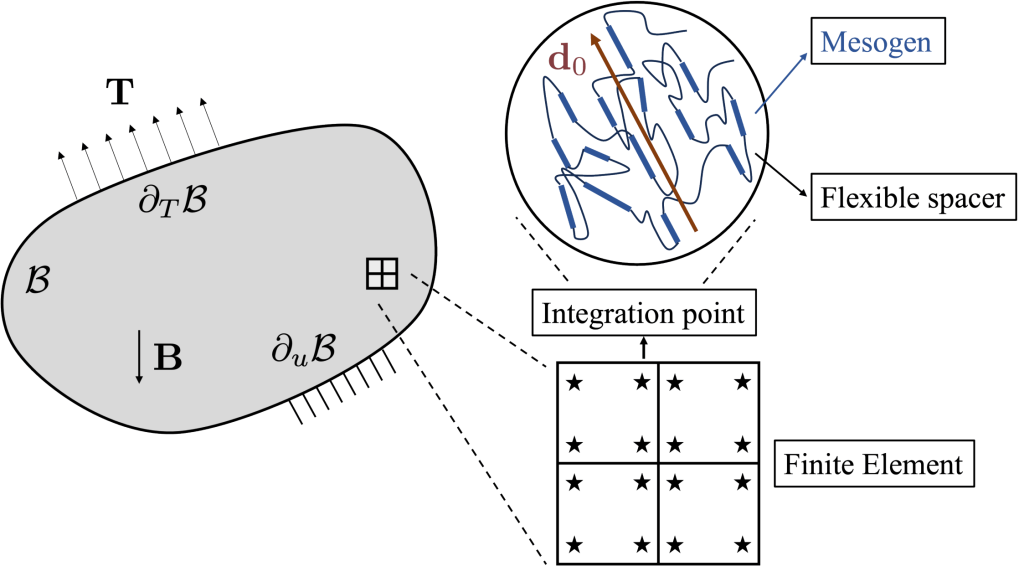
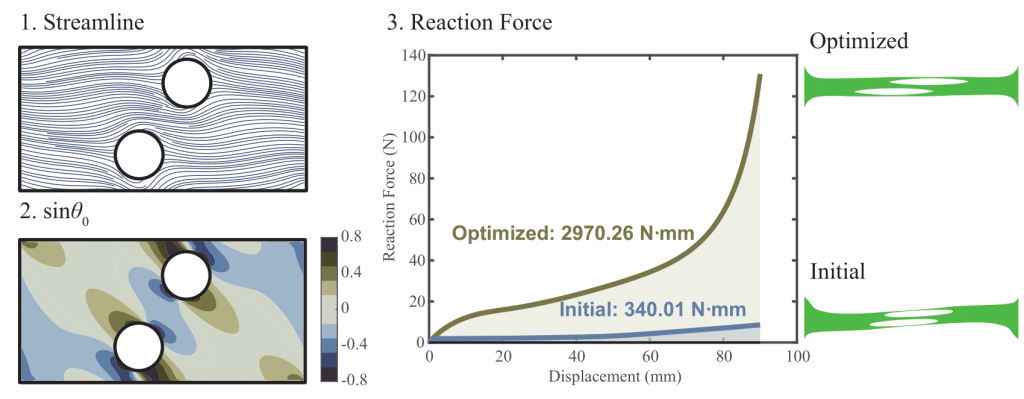
We present a computational framework for optimizing the director distributions in viscoelastic liquid crystal elastomer (LCE) structures. The framework begins with a finite element implementation of a viscoelastic finite strain model to capture the time-dependent behavior of LCEs. This model is coupled with an optimization scheme that optimizes the spatially continuous director field for targeted mechanical performance. A time-dependent adjoint sensitivity analysis is employed to enable efficient gradient-based design updates. The framework is demonstrated through numerical examples that maximize mechanical work and maximize energy dissipation. Maximizing the mechanical work produces optimized director patterns that are aligned with principal stress directions, resulting in minimal reorientation and increased stiffness. Maximizing the energy dissipation produces director patterns that depend on whether viscous director rotation or network deformation is the dominant dissipation mechanism. These results highlight opportunities for optimizing LCE structures and underscore the importance of accurately modeling the viscoelastic response when designing LCE structures for reliable, long-term functionality.
Weathering and Fracture Propagation in Granite
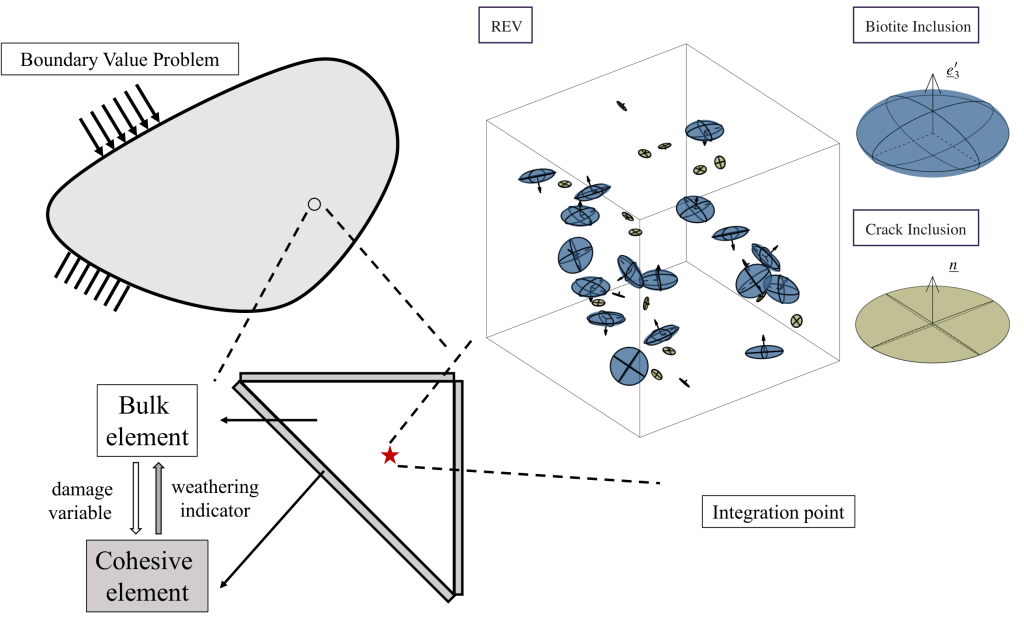
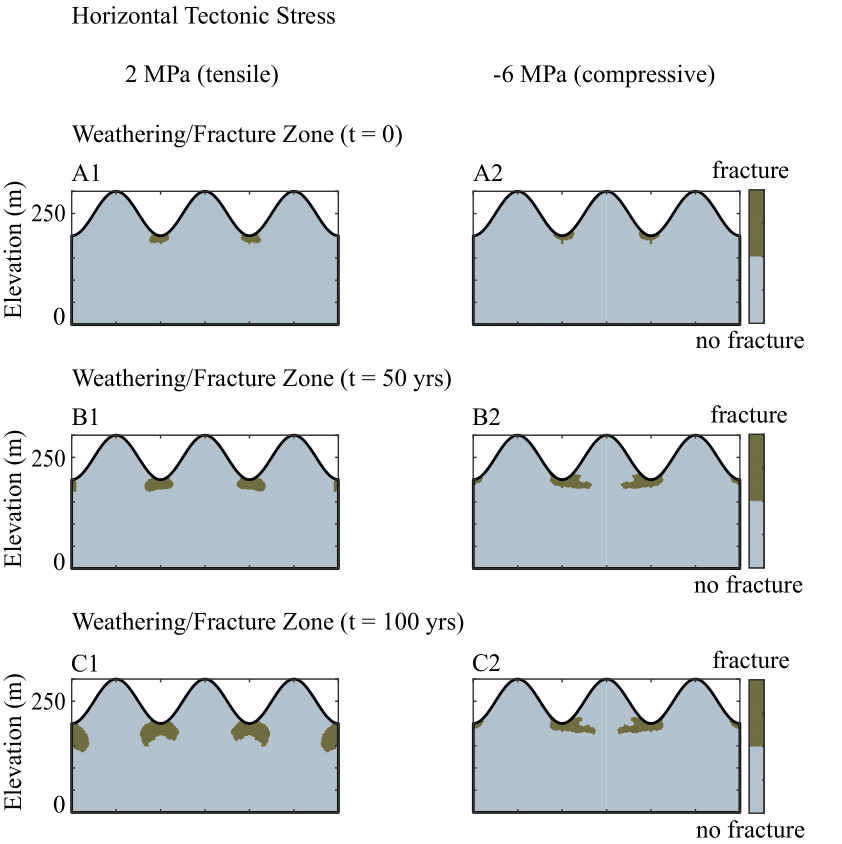
Biotite weathering in granite is known to induce micro-crack propagation. Conversely, fracture propagation exposes fresh surfaces to percolating fluids and enhances fluid flow, which accelerates chemical weathering. These feedback mechanisms between weathering, microcracks and larger fractures remain under-explored. To bridge this gap, a weathering-induced damage model is coupled with a cohesive fracture model to study the joint effects of topographic, tectonic, and weathering stresses in granite. Weathering is simulated over 250 years in sinusoidal topographies. Numerical results suggest that without pre-fracturing, horizontal tectonic stresses are needed to trigger weathering. Under tensile horizontal tectonic stress, simulations indicate that weathering advances vertically beneath the valleys, consistent with field observations. The model predicts that where compressive tectonic stresses are transmitted beneath and parallel to valley bottoms and side slopes, surface-parallel fracturing is promoted, and weathering regions spread laterally beneath both the valleys and ridges, in conformity with fractures observed parallel to and subparallel to the surface. Simulations also indicate that the stress concentrations beneath a valley promotes mode-I fracture propagation where the horizontal tectonic stress is tensile, but does not significantly impact mixed-mode fracture propagation subparallel to the surface where the horizontal tectonic stress is compressive.
Homogenization Scheme for Pressure-solution Driven Healing
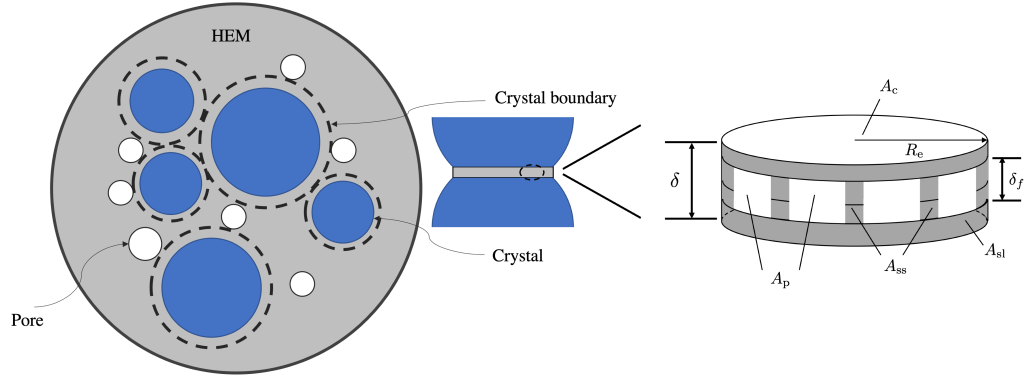
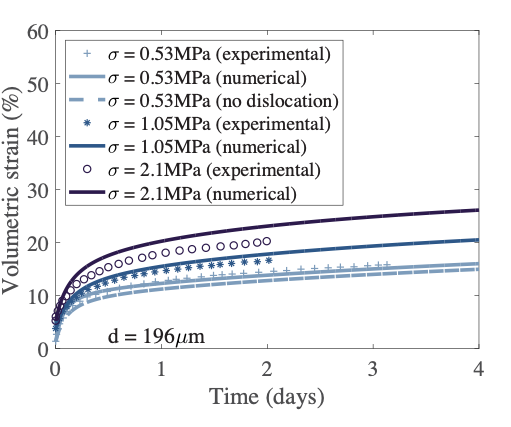
Pressure solution involves mass transfer by dissolution, diffusion, and precipitation in pores or at grain interfaces, which may result in mechanical healing. Dislocation glide is another deformation mechanism that plays a significant role in the behavior of polycrystals. In this work, we use Eshelby’s self-consistent homogenization scheme with imperfect interfaces to calculate the macroscopic mechanical and diffusive properties of an elasto-viscoplastic porous composite made of imperfectly bonded crystals. Using halite as a model material, the proposed self-consistent model is calibrated and verified against published results of experimental creep tests. Simulations highlight that healing by grain boundary precipitation (by contrast with in-pore precipitation) is a limiting factor for pressure solution, because healed interfaces have lower diffusivity than fluid-filled interfaces. The homogenization approach provides an explanatory framework for the lower creep deformation observed for larger grains, and forecasts lower diffusivity for smaller grains. Sensitivity analyses show that grain boundary healing decelerates specimen compaction, while precipitation in the pores controls the evolution of effective diffusivity.